On Emergence, Evolution and Botany
with Illustrations by Guerry Dean and others
 Introductory comment:
Evolution is about self-organization, increasing complexity and the branching diversity of life forms through time, constrained by their ancestral history and their individual selves as well as their surroundings. It's not so much about selection, fitness, competition, reproductive output or cost/benefit we need a deeper causal explanation for the existence of life and its divergence.
Evolution is also not about the tinkering deity central to creationism or "intelligent design." More Than the Sum: On Emergence, Evolution and Botany is a book about science, biology and evolution. It is part memoir, told through my experiences, especially as a graduate student in the Botany Dept. at the University of British Columbia in the early 1980s. This is where I truly began to learn about science, and also and had the good fortune to meet biologists who were exploring possibilities beyond the insufficient neo-Darwinian focus on genes, fitness and selection acting on phenotypes. My book describes the major parts of an alternate explanation of evolution; most of the ideas that make it up have been around for a few decades now and are not mine. At its core, this theory invokes non-equilibrium thermodynamics, or aspects of the Second Law as the underlying cause of biological emergence, development and speciation.
This alternate theory grew initially from the ideas of chemist and Nobel laureate Ilya Prigogine (Order Out of Chaos by Prigogine and Isabelle Stengers, 1984, lays out the basic ideas and demonstrative experiments that point to some version of the Second Law, acting in systems open to the flow of energy, as causing the self-organization and emergence of new forms, such as convection currents, that become more than the sum of their molecular parts.
Could this be the underlying cause of self-organizing life, its intrinsic memory, its increasing complexity and its irreversible change through time? These are the attributes of evolutionary phenomena. Instead of the random drifting of molecules, maybe entropy is dissipated as biological novelty, in self-organized systems able to capture energy, adding surprise to the universe with each unique bit of information that accompanies either individual development or the generation of a new species. Some biologists, including me, were deeply intrigued by these ideas. I try to tell the stories of several people, especially Jack Maze, who have contributed their important insights to this more accurate alternate theory. Empirical approaches to this non-equilibrium view of evolution became the focus of my masters thesis and doctoral dissertation. I have co-authored several scientific papers and would have made this my life's work, but there hasn't been much of a job market over the decades, except in modeling. That's probably just as well.
Chapter 1. Insufficient Explanations
Chapter 3. The Stuff of Science
Chapter 4. One Unavoidable Assumption
Chapter 6. The Demon of Determinism
Chapter 7. Schools of Systematics
Chapter 8. Evolutionary Epiphanies
Chapter 9. Ontogeny and Phylogeny
Chapter 10. Boundaries and Systems
Chapter 11. The Purpose of an Oak Tree
Chapter 12. The Second Law and Evolution
Chapter 14. Love on the Palouse
Chapter 16. Native People, Native Plants
Chapter 17. Virtual Codes and Hierarchies of Time
Bibliography
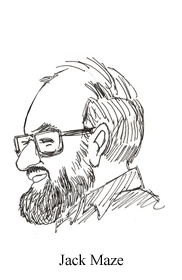
Jack Maze, UBC Botany professor, is a major character in this story. Sadly, he died 26 Feb 2025, a few months after a fall. I miss him. Below is a talk Jack gave in tribute to a course offered by the Univ. of British Columbia for 50 years, Arts One:
I taught in Arts One 94-95 and 95-96. I got into Arts One because Steve Straker asked if I'd like to participate. I thought, First Year
Biology, Arts One. I knew about First Year Biology but not Arts One. I opted for Arts One.
Those in our group were Steve Straker and Ernie Hamm from History, Rebecca Ragland and Nick Hudson from English and me. Our theme was "Nature/Nurture" and there were particular texts to go with that theme, selected readings from Lamarck and Darwin, Lewontin's Biology as Ideology, Annie Dillard's Pilgrim at Tinker Creek and Richard Dawkin's The Selfish Gene. I guess The Second Sex and Frankenstein could be considered part of a nature/nurture theme.
I don't have a long history in Arts One nor do I come from a tradition in the humanities, I like to say I'm just a simple country botanist. So reaction to my years in Arts One are a set of memories, bounded by all originating from my Arts One experience.
The first memory is apprehension, sometimes terror. I was in over my head and knew it; when I want to scare myself I utter, "Hobbes' Leviathan". But I got by with bluff and bluster, teaching experience, and a lot of help from Steve, Ernie, Rebecca and Nick. Ed Hundert and Kay Stockholder also saved my bacon more than once. But it was survived.
Seminars were a delight. There was some constraint on what could be discussed but not so much so that odd, unique or highly creative interpretations couldn't be explored. After offering a rather odd view of some text one student said, "You're trying to warp our minds." My rejoinder was, "I get paid to warp young minds." Not very mature nor in keeping with the eloquence I saw so often in Arts One, but accurate.
I greatly enjoyed the discussions we had about the various texts. I'd been involved in team teaching before, First Year Biology, Ecology, and we would have discussions. But those were often the likes of, "Do cell membranes before osmosis, or Do meiosis before genetics." They were comments that, in my lexicon, addressed "what" and "how." The discussions Steve, Ernie, Rebecca, Nick and I had more addressed meaning in the text, in my lexicon we talked about "why." But I must be honest, they discussed, I listened. I find it odd, what I remember about these discussions. We were talking about Crime and Punishment and Nick commented on the significance of empty rooms and dreams. I'd read the book, one of the best ever written, but that had never dawned on me. Fascinating.
There is another memory from Crime and Punishment. We had a Dostoevsky scholar give one of the lectures. It was a delight. And then he said something that really struck me. "The most important character in Crime and Punishment was Sonja, the teenage prostitute." My first thought was, "OK, seminar subject has been nailed down." My second was that statement's a hypothesis. It has the logical structure of a hypothesis and it's tested just like a hypothesis, setting up of material conditionals, not from the natural world but from a text. I've had a lot of fun with that.
One more memory I want to mention. Steve and I had back-to-back seminars, he was first. I walked in for a seminar on Lamarck, confident. I'd taught Lamarck in "The History and Philosophy of Biology," I am a semi-Lamarckian and my research had a Lamarckian overtone. When I walked in I saw Steve had a diagram on the chalk board. I asked what it was. I can't recall his exact words but the message was it's a diagram showing how Lamarck gave an account for the increasing complexity of life that was central to his views. I stared at it. I'd never thought of it the way Steve presented it but he nailed it perfectly. The irony was not lost on me.
I often think of Arts One. It's the best program at UBC. And why am I, a simple country botanist, qualified to make such a statement? I went to a talk given by the outgoing president of Quest University in which he talked about what a university education should be. I can't recall his words but I don't have to. He described Arts One.
I wanted to offer a summary statement about what Arts One means but could come up with nothing that wasn't rather poor. So I thought, go with your strengths, steal from someone who's smarter than you. At a convocation speech given at the University of Windsor the President said, "Those years of my life convinced me more than ever that a university education is as much about learning how to live a life as it is about learning how to make a living." Should one want to prepare a student for decision-making adulthood, there could be no better way than Arts One.
The evidence from life on Earth tells us that increasing organization and complexity are the trends. Starting with one-celled life forms plus a few billion years, we find all sorts of multicellular life. We find a living, interacting nature that is whimsical with variation and so rich with diversity that we have only cataloged a bit of it. We find a zillion single-celled life forms and also big, wonderful creatures - oak trees, elephants and grizzly bears. Many species are stunningly complex beyond their physical organ systems and physiology; they have awareness, problem-solving capabilities, humor and affection. Homo sapiens, a species that is no more physically complex than many of its fellow life forms, has emergent properties well beyond big mammal attributes. Humans have language, economies, art in many forms, the ability to make intricate tools, and a fearsome capacity for destroying everything around them. Is this magic? Is this miraculous? Maybe, but those are neither satisfying nor scientific explanations. This website accompanies a book exploring other possibilities and acknowledging the contributions of various people to an alternative theory of evolution and development. No single person has all of the ideas, but several people have some critically important pieces. I'd like to try to put them all together because it's just too interesting to resist.
Friends have offered some helpful edits on earlier versions, and I'd like to acknowledge them. Alphabetically, they so far include: Ruth Deery, Melba Dlugonski, Cy Finnegan, Jack Maze and Katalina Severin. Sometimes I quote them and I certainly thank them for taking the time to read this thing and offer suggestions.